

Ibrahim Traoré: Why Burkina Faso’s Young Military Leader Has Become One of Africa’s Most Controversial Figures

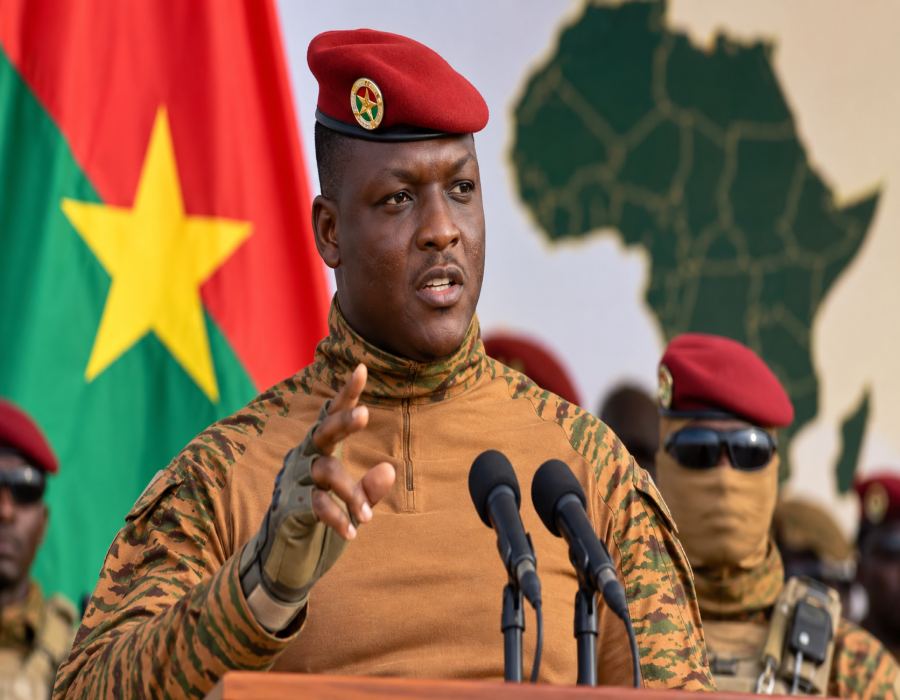
OUAGADOUGOU, Burkina Faso — Few African leaders have generated as much attention beyond their own borders as Captain Ibrahim Traoré.
To many supporters, Burkina Faso’s young military leader represents a new generation of African leadership — outspoken about sovereignty, skeptical of Western influence and determined to make his country more economically and militarily self-reliant.
To his critics, however, the picture looks very different. They point to continued jihadist violence, restrictions on political activity, delayed elections and concerns about civil liberties under military rule.
Nearly four years after Traoré seized power in a September 2022 coup, those competing narratives have made him one of the most recognizable — and polarizing — political figures in Africa.
Who Is Ibrahim Traoré?
Ibrahim Traoré is a Burkinabè army officer who came to power in September 2022 after overthrowing Lieutenant Colonel Paul-Henri Sandaogo Damiba, who had himself taken power in a coup earlier that year.
Traoré's rise came amid widespread frustration over Burkina Faso's inability to contain armed groups linked to al-Qaeda and ISIS operating across the Sahel.
Since taking power, Traoré has built his political message around several recurring themes: national sovereignty, economic independence, military self-reliance, African unity and resistance to foreign domination.
His rhetoric frequently evokes the legacy of Burkina Faso's revolutionary former leader Thomas Sankara, who governed the country from 1983 until his assassination in 1987.
Why Ibrahim Traoré Has Become Popular Beyond Burkina Faso
Traoré's appeal extends well beyond Burkina Faso.
Videos of his speeches circulate widely across TikTok, Facebook, YouTube and other social platforms, where supporters across Africa and the diaspora praise his calls for African sovereignty.
His government has distanced Burkina Faso from traditional Western security relationships while strengthening cooperation with neighboring Mali and Niger.
The three military-led countries created the Alliance of Sahel States (AES) and formally left ECOWAS in 2025.
The alliance represents an effort by Burkina Faso, Mali and Niger to coordinate defense, diplomacy and economic policy outside the traditional West African political structure.
Traoré's Push for Economic Independence
Traoré's political message is not limited to foreign policy.
His government has increasingly emphasized agriculture, domestic production, industrialization and technical education as foundations for national independence.
At Burkina Faso's September 2026 School Excellence Day, Traoré called for a major shift toward scientific and technical education. Government figures presented at the event showed that more than half of roughly 65,000 secondary-school graduates were concentrated in literary studies, while relatively few completed advanced scientific and industrial programs.
The government has continued that emphasis. On September 21, Traoré met winners of the national Hakili Mousso competition, which promotes scientific achievement among young women. Burkina Faso's government said the initiative is intended to encourage students toward mathematics, physics, chemistry and other technical fields.
Read the Burkina Faso government's report on the 2026 School Excellence Day.
But Burkina Faso Still Faces a Serious Security Crisis
The central question surrounding Traoré remains the same one that helped bring him to power: Can his government make Burkina Faso safer?
Armed organizations affiliated with al-Qaeda and ISIS have destabilized large areas of the Sahel for years.
Traoré's government says Burkina Faso's armed forces and civilian Volunteers for the Defence of the Homeland have recovered territory and restored government presence in previously insecure areas.
Independent observers and security analysts have described a more complicated situation, with continued militant violence, displacement and humanitarian needs across parts of the country.
The Russia Question
Another major change under Traoré has been Burkina Faso's foreign-policy realignment.
Relations with former colonial power France have deteriorated significantly, while Burkina Faso has expanded cooperation with Russia.
This shift mirrors developments in neighboring Mali and Niger and forms part of a broader geopolitical transformation across the central Sahel.
Supporters argue that African countries should be free to choose their own partners rather than remain dependent on former colonial powers. Critics counter that replacing dependence on one foreign power with another may not amount to genuine independence.
The Democracy Debate
Traoré came to power through a military coup rather than an election, and Burkina Faso's transition back to civilian government has been delayed.
Supporters of the military government argue that security and territorial control should take priority while the country faces an insurgency.
Critics argue that security threats should not become an indefinite justification for postponing democratic rule or limiting political freedoms.
That disagreement goes to the heart of a much larger debate now unfolding across the Sahel.
Is Ibrahim Traoré Africa's Next Thomas Sankara?
Comparisons between Traoré and Thomas Sankara are common among supporters, particularly online.
There are clear similarities in political imagery: both became national leaders while young, both came from military backgrounds, and both emphasized self-reliance, African dignity and opposition to foreign domination.
But the comparison has limits. Sankara governed Burkina Faso during a different geopolitical era and pursued a distinct revolutionary program. Traoré governs a country confronting a major jihadist insurgency and intense geopolitical competition across the Sahel.
Whether Traoré ultimately develops a comparable historical legacy will depend less on online popularity than on measurable outcomes inside Burkina Faso.
The Bigger Question: Is Africa's Political Mood Changing?
Perhaps the most important story surrounding Ibrahim Traoré is not Traoré himself, but why his message resonates so strongly with parts of the African public.
Frustration with corruption, insecurity, unemployment, foreign influence and governments perceived as unresponsive has created an audience for leaders promising fundamental change.
Traoré has tapped into that frustration by presenting Burkina Faso's struggle as part of a wider battle for African sovereignty.
For supporters, he represents the possibility that African countries can renegotiate old relationships and build a more independent future. For critics, his government illustrates the risks of allowing popular anti-establishment rhetoric to overshadow political freedoms and accountability.
Traoré's Biggest Test Is Still Ahead
Four years after taking power, Ibrahim Traoré's political experiment remains unfinished.
Burkina Faso is attempting to simultaneously defeat an insurgency, rebuild state authority, increase domestic production, reshape its international alliances and redefine its place within West Africa.
The ultimate assessment of Traoré's leadership will therefore depend on more than speeches, symbolism or popularity abroad.
It will depend on whether Burkina Faso becomes safer, more prosperous and more capable of determining its own future — and on what kind of political system emerges in the process.
Bantu Times will continue monitoring developments in Burkina Faso and across the Sahel.


Add new comment